Resin bound driveways
Seamless, permeable stone driveways. What goes under the resin, how long they last and what a proper quote covers.
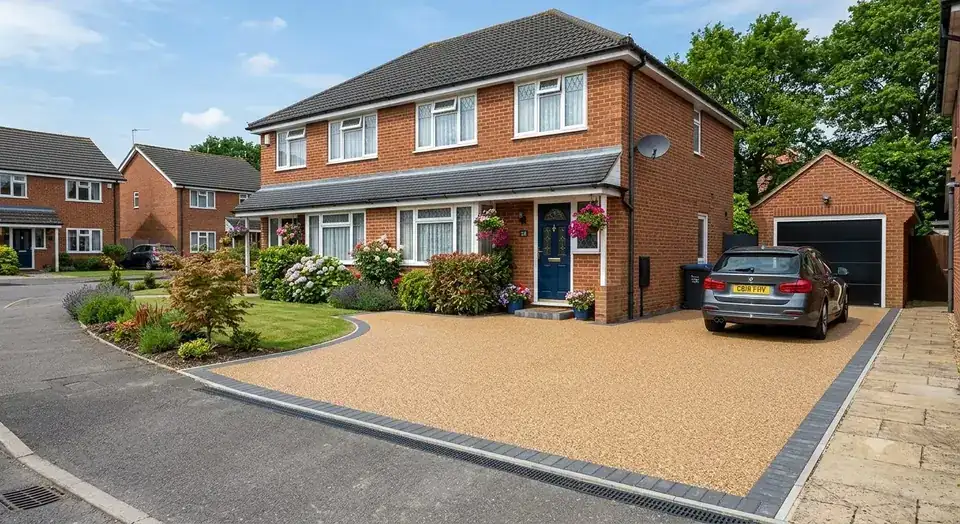
Independent advice on resin bound driveways, patios and paths, and a no-obligation written quotation from one vetted installer who covers your postcode. Most of what decides whether a resin drive lasts is underneath it, so we help you ask the right questions before you sign.
No obligation. Tell us about the job and a vetted local installer will be in touch by email.
Resin bound aggregate is a mix of natural stone and UV-stable resin, trowelled to a smooth, seamless finish. Laid over the right base it drains, resists weeds and needs little more than an occasional wash. These are the jobs installers in our area quote for most often.
Seamless, permeable stone driveways. What goes under the resin, how long they last and what a proper quote covers.
Seamless garden terraces with no joints for weeds. Bases, levels near the house and slip resistance.
Level, accessible paths with no loose stone. Ideal for side returns, front paths and garden routes.
How a resin drive actually drains to ground, and why that matters for planning and flooding.
Overlay or full rebuild? How to tell which your drive needs, and what each involves.
Permeable, textured surrounds that shed water quickly. Slip resistance, chemicals and colour choice.
When an existing concrete drive is a good base, and the cracks, joints and drainage issues to check.
Turning a sound tarmac drive into a resin finish without digging out, and when it is not suitable.
Forecourts, car parks, school paths and public realm. Build-ups, loading and drainage for commercial sites.
Loose stones, cracking, fading and ponding: what causes each and how they are put right.
Choosing a blend that suits your house and shows less dirt, with borders and sample tips.
A resin bound surface is typically 15 to 18 mm thick. It has very little strength of its own. Whether it cracks, sinks, ponds or lasts for decades is decided by what it is laid on, which is why two quotes for the same drive can differ so widely.
Government guidance puts a typical driveway construction at 200 to 250 mm beneath the surface. Ask every installer exactly what they will lay under the resin and how deep. Our installation guide explains what good looks like.
We keep it simple and low-pressure. No phone number to chase you, no list of firms competing for your details.
Two minutes online: postcode, surface and timescale. No phone calls unless you ask for one.
Your enquiry goes to a single vetted installer covering your area, not to a list of firms competing for your number.
The installer checks your base, drainage and levels, then sends a written, itemised quotation.
No obligation. Compare it against any other quote using our installer checklist.
Guildford's housing runs from Victorian terraces near the town centre to large detached homes on the edge of the Surrey Hills. Across Surrey, 32.2% of households live in a detached house against 22.9% nationally, and 46.9% of households run two or more vehicles, so driveway space matters here (Census 2021 data). The borough also has 40 conservation areas, where planning rules can be tighter. Each area page covers the local planning authority, conservation areas and ground conditions installers check for.
Town centre, Merrow, Burpham, Stoughton, Onslow Village and West Clandon.
Godalming, Farncombe, Milford, Busbridge and Witley.
Woking, Horsell, Knaphill, St John's, Pyrford, Mayford and Old Woking.
Farnham, Wrecclesham, Rowledge, The Bourne, Badshot Lea and Tilford.
Cranleigh, Ewhurst, Alfold and the GU6 villages on the Weald Clay.
Haslemere, Hindhead, Grayswood, Shottermill and Beacon Hill.
Ash, Ash Green, Ash Vale and Tongham on the western edge of Guildford borough.
Send, Send Marsh, Ripley and Burnt Common beside the Wey Navigation.
East Horsley, West Horsley, Effingham and Great Bookham borders.
The villages south of Guildford along the Wey and Tillingbourne.
The Tillingbourne valley villages in the Surrey Hills.
Worplesdon, Jacobs Well, Wood Street, Normandy and Pirbright north-west of Guildford.
Clear answers on the questions homeowners ask most, written to help you judge any quotation, whoever you choose.
For journalists and researchers, our resin driveway and UK paving statistics compile 59 sourced data points with a downloadable dataset.
No. We are an independent introduction service operated by HHR Holdings Ltd. We publish guidance and pass your enquiry to one vetted installer covering your postcode. The installer surveys, quotes, carries out the work and provides any guarantee under their own terms, so check those terms before you sign.
Usually not, if it is permeable or drains to a lawn or border. Since 1 October 2008, impermeable front-garden surfaces over 5 m² that drain onto the road need permission. Conservation areas, listed buildings, flats and new dropped kerbs follow separate rules. See our planning permission guide.
It depends mostly on the base. Overlaying sound tarmac or concrete costs far less than excavating and building a new sub-base. Our cost guide explains what drives the price and shows published industry ranges, but only a site visit gives a reliable figure.
No. Resin bound mixes stone and resin together and trowels it smooth, giving a permeable surface with no loose stones. Resin bonded scatters stone onto a resin coat, giving a textured, non-permeable finish that can shed stones. See resin bound vs resin bonded.
The installer for your area contacts you by email to arrange a site visit. They check your existing surface, levels and drainage, then send a written quotation. There is no obligation to go ahead.